
You may still think of search as something that happens primarily on Google. That is no longer the full picture.
Your customers may discover a product through TikTok, Instagram, YouTube Shorts, or another social platform before they ever visit a traditional search engine. They search for product reviews, tutorials, local businesses, and recommendations where they already spend time.
Recent 2026 consumer research reflects this shift. Younger consumers, especially those between 18 and 34, increasingly use social platforms as discovery and research tools. YouGov reports on the growing role of social media in product discovery, while TikTok itself describes search and discovery as important parts of the customer journey.
So what should your business do?
Build a connected system. Make your brand recognizable, your website easy to use, and your video content understandable with the sound off.
That is the story behind this week’s Mk5 Studios Highlight Reel.
1. Why was this athletic brand losing attention even though its product was strong?
The product itself was not the main problem.
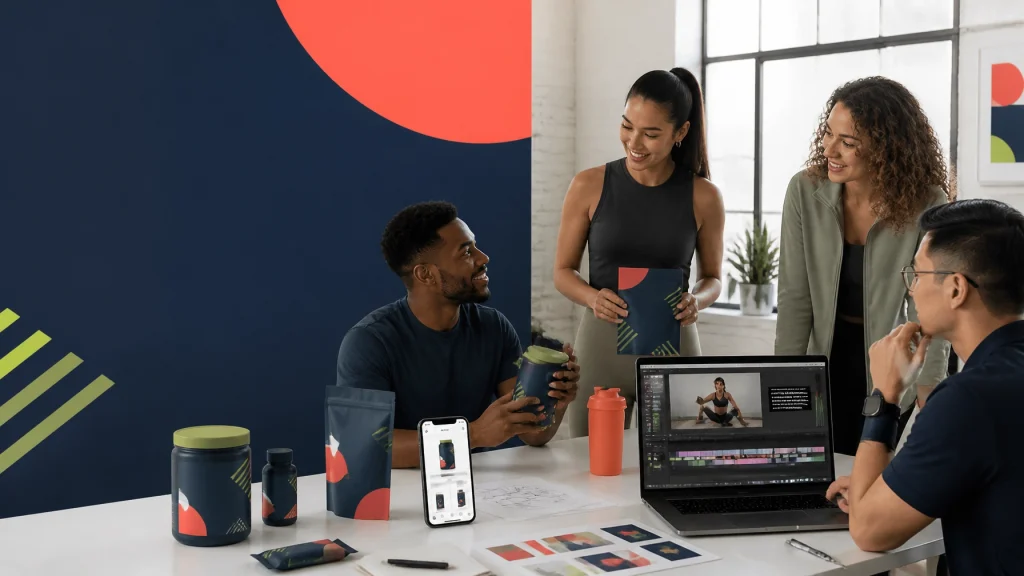
This anonymized athletic and wellness brand had a useful product, loyal customers, and a legitimate reason to exist. However, its visual identity had become inconsistent. Packaging looked different from social media. Social graphics varied from post to post. Product pages answered some questions but ignored others.
Meanwhile, competitors were showing up in social search with polished videos, clear product demonstrations, and recognizable visual systems.
The brand was not invisible because it lacked effort. It was becoming difficult to recognize.
That distinction matters.
When a customer sees one color palette on a product label, another on Instagram, and a completely different experience on the website, the brain has to work harder to decide whether the company is credible. Confusion creates friction. Friction weakens consumer confidence.
The first step was not to create another isolated graphic. It was to establish a visual and messaging foundation the brand could use everywhere.
2. What does a brand system do that a logo cannot?
A logo identifies your business. A brand system helps people remember and trust it.
For this project, Mk5 organized the brand around a practical set of visual rules:
- A focused color palette that worked across packaging, web, and social content
- A consistent typography hierarchy for headlines, product benefits, and supporting information
- Repeatable label and packaging layouts
- Social media templates that could be customized without losing recognition
- A clear image direction centered on real use, movement, and wellness
- A tone that was confident and educational without making exaggerated claims

This is where professional graphic design services in Houston become more than decoration. Good design gives your team a repeatable decision-making tool.
Should this new label use a different typeface? No. Does this social graphic need another color? Probably not. Does this product image fit the brand? Verify it against the system.
That simplicity saves time. It also protects legitimacy.
Do not stress if your current brand feels scattered. It is simpler than you think to begin. Start by documenting the elements your customers see most often, then create rules that make those elements consistent.
Be wary of anyone who promises that a new logo alone will transform your sales. A logo can support growth, but it cannot replace a clear offer, reliable service, or a thoughtful customer experience.
3. How did the website turn social discovery into a buying decision?
The brand’s Shopify store needed to do more than look attractive. It needed to answer the questions people brought with them from social media.
A viewer might discover the product through a 20-second video and immediately ask:
- What problem does this product solve?
- Who is it for?
- How do I use it?
- What makes it different?
- Is it worth the price?
- What should I expect after ordering?
We used those questions to shape the product-page structure. Instead of burying the important information below several promotional sections, the pages made the product’s purpose, use case, and benefits easier to understand.
The process included:
- Reviewing the customer questions and objections surrounding the product
- Grouping those questions by buying intent
- Restructuring product pages around clear sections and scannable copy
- Matching the site’s colors, imagery, and typography to the new brand system
- Optimizing the mobile experience for users arriving from social platforms
- Reducing unnecessary visual and technical elements that slowed the path to action
- Testing the site across common screen sizes before launch

This is the heart of effective custom website development. Your website should not force visitors to decode your business. It should guide them.
A fast website is important, but speed is not the only goal. The page must also feel familiar when someone arrives from a social video. The product, colors, language, and promise should connect across both experiences.
For a WordPress website, the same principle applies. Whether you need an informational site, a campaign landing page, or a WooCommerce store, build around the questions your audience actually asks.
And remember: nobody can honestly guarantee a specific ranking position or conversion rate. Performance depends on your offer, competition, technical setup, content, and customer experience. A responsible creative partner will explain the variables instead of selling certainty.
4. Why were captioned videos central to the new search strategy?
Social search rewards clarity.
A short-form video has only a few seconds to tell viewers what they are seeing and why it matters. If the product, category, or use case is unclear, the viewer may scroll away before the story begins.
Mk5 created a library of short-form product videos designed around real questions and practical moments. The content showed the product in use, explained its purpose, and gave viewers a reason to continue watching.
Captions were treated as part of the edit, not as an afterthought.
That meant:
- Using high-contrast text that remains readable on a phone
- Placing captions away from platform interface elements
- Making the opening message understandable without audio
- Including relevant product language in spoken dialogue and on-screen text
- Using pacing that supported comprehension rather than chasing constant cuts
- Adding motion graphics only when they clarified the message
- Color grading footage for consistency across the video library

This is what professional video editing services for business should accomplish. The edit should make the message stronger without making the brand feel artificial.
Color grading helped the footage feel like it belonged to the same company. Motion graphics highlighted product details and instructions. Sound design supported the story. Captions made the content more accessible and useful in silent viewing environments.
Most importantly, the videos still felt human.
Do not confuse polish with perfection. Consumers are often more responsive to clear, honest demonstrations than to content that looks overproduced but says very little.
5. What changed when the three pieces worked together?
The brand stopped treating packaging, web design, and video as separate projects.
A product package became a visual reference for a social template. A social video led to a product page that used the same language. A product page answered questions that could become future video topics.
That is the advantage of a connected creative process.
The project produced a more consistent brand experience, a clearer ecommerce journey, and a reusable video library the team could continue building from. Instead of starting from a blank page every time, the brand had a working system.
The outcome was not a magic ranking claim or a promise of overnight virality. It was more durable:
- The brand became easier to recognize
- The product story became easier to understand
- The store created fewer unnecessary steps between discovery and purchase
- The internal team had repeatable creative tools
- Customers received a more legitimate and confident first impression
That is validation. That is operational clarity. That is how design supports growth.
6. What should your business build next?
Ask yourself three questions:
Can customers recognize your business across your website, social profiles, packaging, and marketing materials?
If not, begin with a brand system. A focused identity is especially valuable if you are searching for a branding agency for startups or preparing for a major refresh.
Does your website answer the questions people ask before contacting or buying from you?
If not, review the structure, page speed, mobile experience, and content hierarchy. A website should be beautiful, but it must also function as a clear business tool.
Can someone understand your video with the sound muted?
If not, improve the captions, opening hook, pacing, and visual explanation. Make sure to stay relevant to how people actually discover information today.
At Mk5 Studios, we bring these pieces together through graphic design, website design and development, and video post-production. Our approach is straightforward: understand the business goal, build what supports it, and avoid needless tweaking that does not improve the result.
Whether you need marketing material design, a Shopify store, a WordPress website, or a library of polished social videos, your next step should create clarity: not more clutter.
Contact Mk5 Studios to discuss your next web, design, or video project.
A strong creative system gives your business more than attention. It gives customers a reason to believe you are prepared, capable, and legitimate.