
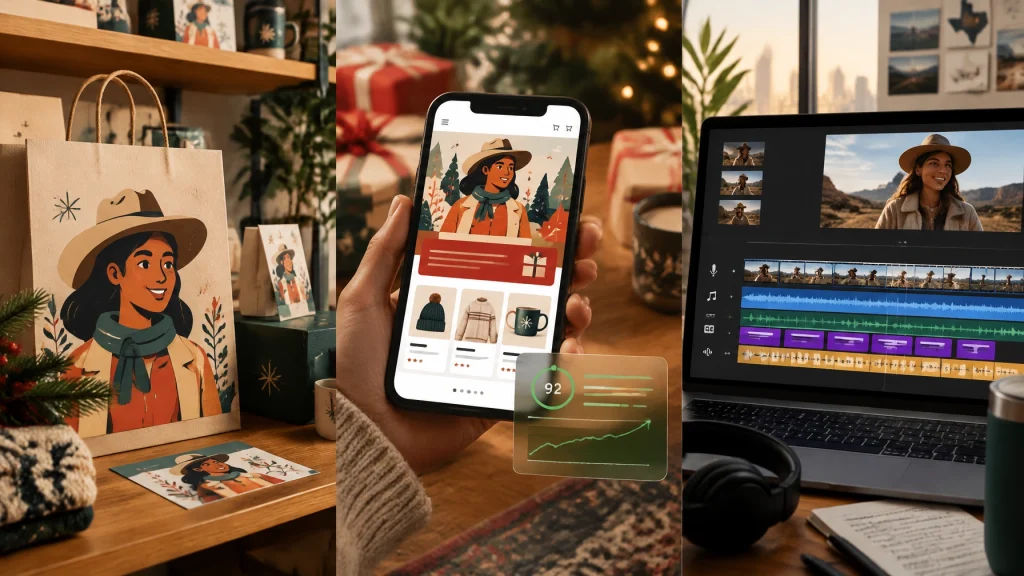
Your holiday marketing is only as strong as the system behind it. In this Highlight Reel, we share three anonymized Mk5 Studios projects: a character-led brand system for seasonal retail, a Shopify BFCM speed audit that exposed mobile friction, and a holiday video whose missing sound layers were weakening the message. The common thread? Validate the details before peak season validates them for you.
What can a character-led brand system do for a consumer product brand?
A well-built character system gives your brand a recognizable personality that can travel consistently across packaging, retail displays, digital graphics, and video.
DIELINE’s 2026 trend reporting points toward expressive characters, caricatures, tactile packaging, and premium finishes that feel “rich, not snobby.” That direction made sense for a Texas consumer product brand preparing a holiday retail push.
The challenge was not simply “draw a mascot.” It was to create a usable visual asset system.
Our team developed a vector brand character and integrated it into the identity, packaging, shelf collateral, and seasonal bundle structure. The character became the visual anchor for product groupings and naming, helping shoppers understand which products belonged together without forcing them to decode a complicated shelf.
This was graphic design and brand-system work, including vector logo and brand asset development. It was not positioned as a standalone hand-drawn illustration service.

How do you keep a mascot from becoming a one-off graphic?
Define rules for how the character behaves before creating dozens of applications.
We considered:
- Personality: Is the character playful, reassuring, energetic, serious, or clever?
- Scale: Does the character remain recognizable on a package, a shelf talker, and a social media graphic?
- Expression: Which expressions support product education, gifting, or promotion?
- Color: Can the character work in full color, one color, and limited-print applications?
- Production: Can vendors reproduce the artwork accurately across different substrates and printers?
The system also supported a holiday bundle structure built around the hero character. That made the bundle easier to name and easier to recognize. It gave the shopper a story, not just a stack of products.
For startups, this kind of thinking can be the difference between a temporary logo and a flexible identity. For established brands, it can help refresh a familiar visual language without throwing away hard-earned recognition. That is the value of working with a branding agency for startups that understands how identity decisions move into production.
What should you validate before sending character-led packaging to print?
Validate both the creative system and the technical file.
Use this practical print checklist:
- Confirm bleed and safe areas on every panel.
- Match artwork to the approved dieline.
- Convert or verify colors for CMYK production.
- Check small type at actual viewing size.
- Confirm barcode placement, contrast, and quiet zones.
- Review the design from the expected viewing distance.
- Keep one approved source file for printers, vendors, retail collateral, and future adaptations.
A strong concept builds emotional connection. A controlled production file builds legitimacy. You need both.
Why should you run a Shopify BFCM speed audit in October?
Because October is the last practical window to make structural changes before Black Friday and Cyber Monday traffic arrives.
We audited a Shopify merchant whose storefront looked acceptable on desktop but struggled in its full holiday state on mobile. The issue was not one dramatic error. It was accumulated friction: app scripts, theme bloat, third-party tools, promotional elements, heavy media, and a checkout experience that had not been tested thoroughly on real devices.
The first step was an inventory of the store’s apps and templates. We looked for unused apps, duplicated functionality, leftover scripts, and features that were technically installed but not actively supporting revenue.
Then we tested the store with its holiday components turned on:
- Promotional banners
- Pop-ups
- Countdown timers
- Seasonal homepage sections
- Product videos and large imagery
- Discount logic
- Mobile navigation and cart behavior
The point was simple: a store should not be judged in its quiet-season state if customers will experience it in its holiday state.
What Shopify performance signals should you monitor?
Use field data and real-user monitoring, not a single desktop lab score.
At the mobile 75th percentile, common Core Web Vitals targets are:
- LCP: 2.5 seconds or less
- INP: 200 milliseconds or less
- CLS: 0.1 or less
These are useful targets, not guarantees of sales. A fast page can still have weak positioning, unclear offers, or confusing checkout copy. However, slow pages create avoidable friction before those other decisions even have a chance to work.
Our audit covered:
- App and script inventory
- Theme and template bloat
- Third-party JavaScript
- Image and video weight
- Mobile LCP, INP, and CLS
- Real-device checkout testing on iOS and Android
- Discount and shipping verification
- CDN and DDoS protection
- Real-user monitoring setup
- A structural freeze before peak traffic

What should you freeze before BFCM?
Freeze major structural theme changes at least 14 days before Black Friday whenever possible.
That does not mean you stop monitoring the store. It means you stop introducing unnecessary variables. After the freeze, limit changes to critical fixes, verified content updates, and emergency corrections.
Be especially wary of anyone promising a guaranteed conversion lift, guaranteed revenue, or a guaranteed BFCM result from a speed project. Performance work is a revenue decision because it removes friction, but outcomes still depend on the offer, audience, inventory, trust, pricing, and execution.
If your business runs on WordPress, the same principle applies. Audit caching, plugin sprawl, image formats, hosting, embedded media, and mobile layouts before a campaign launches. For a broader review, see our Shopify website design guidance and website design services in Houston.
Validation means testing the real holiday experience. Legitimacy means knowing what changed, why it changed, and whether the store remains stable afterward.
Why does holiday video need sound design if most social viewers watch on mute?
Because your video has to work in two modes: clear without sound and emotionally complete with sound.
A service and athletic brand came to us with a holiday campaign that looked polished on mute but lost energy when sound was enabled. Dialogue was muddy. The music did not match the pace of the edit. Captions arrived slightly after the important moments.
The visuals were not the only problem. The sound layer was unfinished.
Our post-production pass included:
- Dialogue cleanup and noise reduction
- Music-bed selection based on pacing and audience
- Comparison of licensed music with AI-generated scratch music
- Sound effects synced to movement and transitions
- Loudness normalization for platform delivery
- Caption timing matched to speech and visual beats
- Two final mixes from one master edit
The two-delivery approach mattered. One version was designed as a sound-on hero video. The other prioritized sound-off social viewing with stronger captions and visual communication.

Where can generative audio help a business video editor?
AI audio is useful for exploration and versioning, but it does not replace human editorial judgment.
Adobe’s 2026 Firefly expansion, including Generate Music, Generate Speech, and Generate Sound Effects, makes it easier to create scratch tracks, temporary voiceover, rough sound-effect beds, and alternate versions. That can help a team test pacing before spending time on a final mix.
But ask a more important question: does the sound serve the story?
Human post-production judgment still decides whether dialogue feels trustworthy, whether music gives a moment room to breathe, whether a sound effect feels natural, and whether the final loudness works across platforms. Licensing, voice permissions, brand suitability, and delivery specifications also require careful review.
A tool can generate options. It cannot take responsibility for the emotional rhythm of your campaign.
Mk5’s video editing services for business include editing, color grading, motion graphics, animation, sound design, audio mixing, and visual effects. The goal is not to add noise. It is to make the message easier to feel and understand.
That is what turns a technically complete video into a legitimate brand experience.
What should you validate before your holiday campaign goes live?
Validate the system, the storefront, and the final media, not just the first draft.
Use this recap:
- Brand system: Can your character, logo, color, and type work consistently across packaging, web, social, and print?
- Print production: Are bleed, dielines, CMYK, type size, barcode placement, and viewing distance correct?
- Shopify performance: Did you test the store with every banner, pop-up, timer, app, image, and video enabled?
- Real devices: Did you test checkout on current iOS and Android devices using real discount and shipping conditions?
- Monitoring: Do you have field data or RUM in place to detect mobile performance drift?
- Video clarity: Does the campaign communicate the core message without sound?
- Audio quality: Is dialogue clean, music intentional, captions synchronized, and loudness normalized?
- Claims: Has every marketing or performance claim been verified rather than assumed?
Need packaging, a site audit, or a campaign edit? Mk5 Studios helps businesses across Greater Houston, Dallas, Austin, and the wider US connect beauty with function, without needless complexity.
Ready to validate your next brand, website, or video project?
Talk with our team about:
- Graphic design services in Houston
- Shopify and WordPress website design
- Marketing material design and printing
- Apparel and tradeshow display printing
- Video editing and post-production
Contact Mk5 Studios about your project.
Frequently Asked Questions
How early should a Shopify store prepare for BFCM?
Begin technical preparation in October. Complete major theme and structural changes before the final two weeks, then freeze the store for stability while continuing to monitor performance and checkout behavior.
What are good mobile Core Web Vitals targets for Shopify?
Aim for LCP of 2.5 seconds or less, INP under 200 milliseconds, and CLS under 0.1 at the 75th percentile. These are performance targets, not guarantees of traffic, sales, or conversion rate.
Is a mascot the same thing as a logo?
No. A logo identifies the business, while a character or mascot can express personality and support storytelling. They can work together inside a larger brand system.
Can AI generate the music and sound effects for a business video?
Yes, AI tools can help create scratch tracks, speech, music, and sound effects. Final audio still needs human review for pacing, clarity, licensing, brand fit, loudness, and emotional impact.
Why do holiday videos need captions if sound design is important?
Because many viewers encounter social video with sound disabled. Captions and visual storytelling preserve the message on mute, while a thoughtful mix gives the sound-on version greater depth and emotional connection.