
Meta description: See how Mk5 Studios connects holiday signage, agentic-ready Shopify design, and transcript-rich video editing to help businesses earn attention in stores, search, and AI-assisted shopping.
AI is changing how people discover products, compare businesses, and decide where to spend their money. But do not mistake that shift for the end of physical marketing or human storytelling.
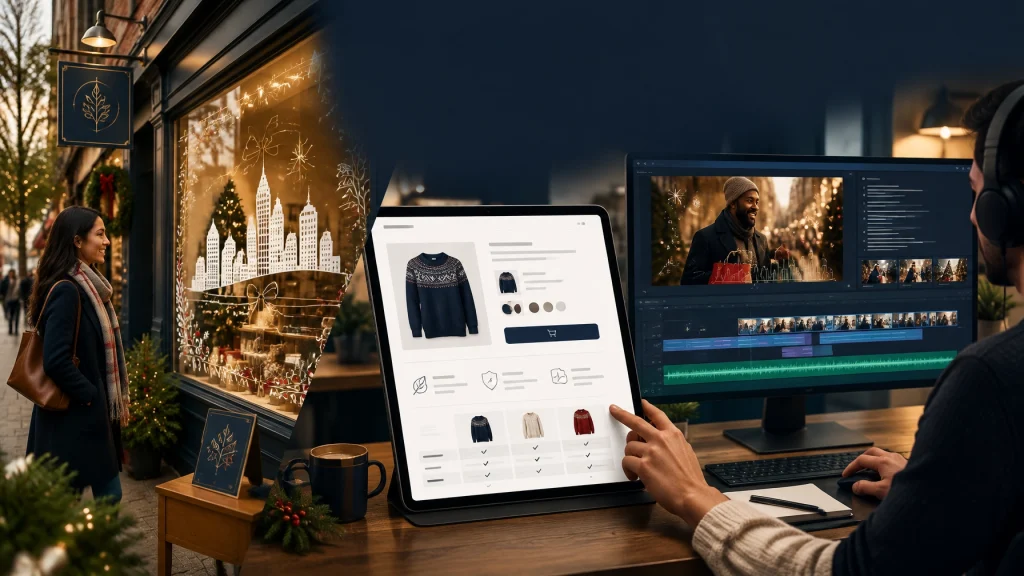
In our latest Mk5 Studios Highlight Reel, we are looking at three connected changes shaping the 2026 holiday season:
- Physical spaces matter more when AI controls more online discovery. Clear holiday signage, window graphics, wall art, and promotional materials can turn a visit into a memorable brand experience.
- Shopify stores must become easier for both shoppers and AI agents to understand. Plain-language product facts, structured data, real reviews, and fast mobile pages are no longer optional details.
- Video transcripts are becoming searchable content assets. A well-edited explainer can now support human viewers, search engines, and AI tools, provided the edit is accurate and clearly organized.
We cross-checked these angles against current U.S. search and marketing signals for October 2026. Google Trends measures relative interest rather than guaranteed search volume, so no agency can promise a specific ranking, citation, or sales result. Still, the direction is clear: holiday buying is becoming more conversational, more visual, and more connected across physical and digital touchpoints.
1. How can holiday signage pull more foot traffic into a local business?
Holiday signage works when it is designed for the actual room, street, or storefront, not simply resized from a digital graphic.
A person driving past your business has only a few seconds to notice your window. A customer standing inside may view a wall mural from 20 feet away under uneven lighting. A tradeshow attendee may see your display while walking through a crowded aisle.
Those conditions change the design.
At Mk5, we begin with the practical questions:
- What is the viewing distance?
- Which sightlines matter most?
- Will the sign be read through glass, under bright lights, or outdoors?
- Does the material need to resist weather, fingerprints, or repeated handling?
- Should the design be removable after the holiday season?
- Can the message be understood without a salesperson explaining it?
A beautiful design that cannot be read is not doing its job. Legibility, durability, and consistency create consumer confidence, and that confidence supports legitimacy.
A Houston-area client story
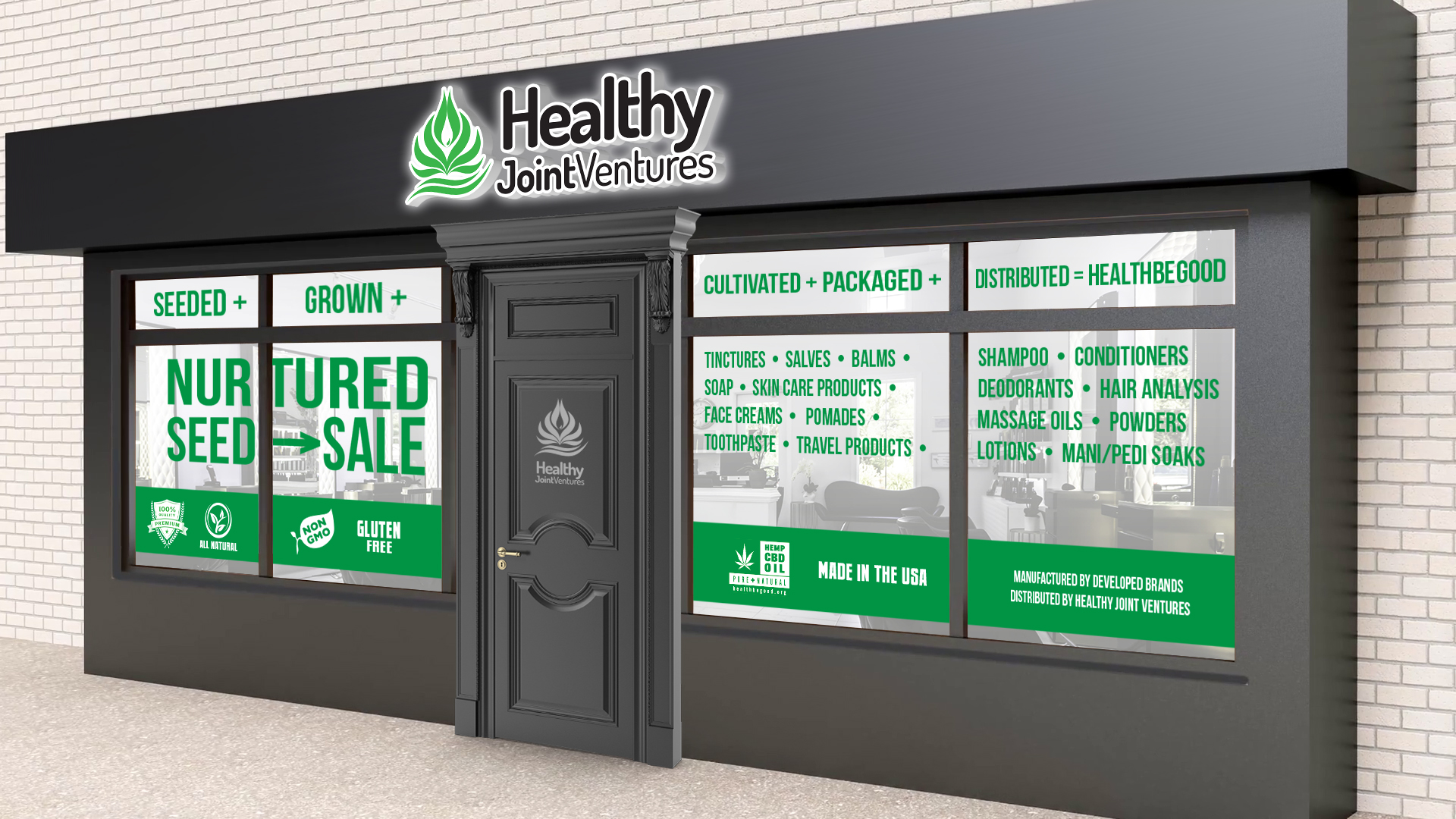
For one Houston-area clinic and retail client, our team helped shape a coordinated holiday look across the customer’s space. The project included seasonal signage, window graphics, and supporting print collateral that worked together instead of appearing as disconnected one-off pieces.
We created the graphic system, prepared vector artwork and production-ready files, and coordinated with our printing partners for production. The goal was not to add decoration for decoration’s sake. The goal was to help people understand where to enter, what seasonal offer was available, and what the business wanted them to notice first.
That same approach can extend to:
- Window graphics and removable decals
- Wall murals and branded wall art
- Holiday sale signs and point-of-purchase displays
- Brochures, flyers, postcards, and counter cards
- Tradeshow backdrops and pop-up displays
- Directional signage and room-specific graphics
- Branded apparel and promotional materials
Do you need hand-drawn illustration for this type of campaign? Not necessarily. Mk5 focuses on graphic design, layout, vector work, brand systems, production files, and vendor coordination. We use the right visual tools for the job rather than adding unnecessary complexity.
Make sure your physical marketing can be understood at a glance. Use fewer words, stronger contrast, a clear call to action, and a visual hierarchy that guides the eye. If the display includes a QR code, connect it to a useful mobile page, not a generic homepage.
The result is not merely decoration. It is a physical brand touchpoint that reinforces recognition, relevance, and legitimacy.
2. What makes a Shopify store ready for agentic shopping?
An agentic-ready Shopify store makes product information easy for both people and AI systems to find, compare, and trust.
Shopify describes 2026 as the first holiday season of the agentic era. Its reporting says shoppers are increasingly using AI to research products, compare options, and discover independent brands. Salesforce has also reported substantial growth in AI-assisted shopping discovery.
So what does an AI assistant need before recommending your product?
It needs clear evidence.
Start with plain-text product facts:
- What is the product made from?
- What are the exact dimensions?
- Who is it for?
- How does sizing work?
- Which colors or variants are available?
- When will it ship?
- What does shipping cost?
- What is the return policy?
- How does this product compare with alternatives?
- What do real customers say about it?
Do not hide essential information inside an image, carousel, or decorative graphic. Real HTML text gives shoppers something they can scan and gives search systems clearer information to interpret.
Your Shopify website design should also support:
- Clean structured product data. Use accurate product, offer, availability, review, shipping, and return information where appropriate.
- Comparison-friendly layouts. Help shoppers understand differences between variants or related products.
- Answer-first product pages. Address common questions near the top instead of burying them below long promotional copy.
- Fast mobile performance. Holiday shoppers research while commuting, standing in a store, or comparing products on a phone.
- A complete variant library. Each size, color, bundle, or configuration should have consistent names, images, inventory details, and pricing.
- Real reviews. Never manufacture testimonials or use vague claims that cannot be verified.
A product-brand Shopify example
For a product brand, Mk5 reorganized Shopify pages around plain-text specifications, structured product information, and a BFCM-ready variant library. The work focused on making the catalog easier to browse before the holiday rush, not merely adding a temporary Black Friday banner.
We also considered how a shopper might ask for the product conversationally. Someone may not search for your internal product name. They may ask for “a lightweight gift for a runner,” “a durable option under $100,” or “a product made without synthetic fragrance.”
Your pages should explain the product in the language your customers actually use.
Publish gift guides, comparison pages, and seasonal product collections early. AI engines and search systems can take time to discover, process, and reassess new content. Launching a page in mid-November does not guarantee it will be visible when demand peaks.
Shopify’s report on the first holiday season of the agentic era and Google’s holiday agentic commerce updates both point to the same practical lesson: product data must be accurate, complete, and useful before the shopper, or the shopper’s assistant, asks for it.
Be wary of anyone claiming that adding schema will guarantee AI recommendations. It will not. Structured data helps clarify your information; it does not replace product quality, customer trust, reviews, or a compelling brand.
That combination is what creates validation and legitimacy.
3. Why are video transcripts becoming AI-search assets?
A video with an accurate transcript, readable captions, descriptive titles, and clear chapters gives AI systems more useful information to understand and quote.
Video used to be judged mostly by views, watch time, and engagement. Those metrics still matter. But a business video now has another job: it must clearly communicate what the company offers, who it serves, and why the viewer should care.
That changes the edit.
For a short explainer or product demo, we recommend:
- Put the main hook in the first few seconds.
- Use a descriptive title rather than a vague campaign name.
- Speak product names and important terms accurately.
- Match spoken names with on-screen text.
- Add readable captions and a complete transcript.
- Organize longer videos with chapters or clear sections.
- Keep the audio clean so transcription tools do not mishear key details.
- Use a consistent color grade so the brand feels reliable from clip to clip.
- Add motion graphics that clarify rather than distract.
If your spokesperson says a product name incorrectly, the transcript may repeat that error. If background music competes with dialogue, captions may become less accurate. If your on-screen text uses an abbreviation that never appears in the spoken audio, an AI tool may miss the connection.
This is why video editing services for business are not simply about cutting footage faster. The edit has to support communication, accessibility, brand consistency, and discoverability.
A one-shoot, many-assets story
For one Mk5 client, we helped turn a single shoot into a set of short explainer clips. Instead of delivering one long video and leaving the client to figure out the rest, we shaped the footage into focused pieces with distinct topics, readable captions, branded motion graphics, and transcript-ready dialogue.
That created a more useful content library:
- A primary explainer video
- Short product or service clips
- FAQ-style videos
- Social media edits
- Captioned versions for silent viewing
- Transcript-rich pages that could support search and AI discovery
Our post-production process can include editing, color grading, audio mixing, motion graphics services, animation, and visual effects. Each element should serve the message. A flashy transition cannot rescue unclear positioning.
Google is also expanding conversational shopping experiences across search and YouTube, which makes product demonstrations and answer-focused video increasingly valuable. Still, no one can guarantee that an AI system will quote your transcript or cite your page. Give the system clear, accurate material, but keep the human viewer at the center.
A transcript is not a magic SEO button. It is a durable content layer that improves accessibility, supports repurposing, and makes your expertise easier to interpret.
That clarity strengthens trust, validation, and legitimacy.
What ties these three shifts together?
The strongest holiday marketing systems connect the physical experience, the digital storefront, and the video story under one clear brand system.
Your window graphics should reflect the same offer your Shopify page explains. Your product video should use the same names and benefits found in your catalog. Your promotional print materials should direct customers to a mobile page that works quickly and answers their questions.
That is where experienced creative direction matters.
Whether you need a creative agency in Houston, graphic design services in Houston, small business web design in Texas, professional logo design services, custom website development, or video post-production, the goal is not to chase every trend. It is to build a consistent customer experience that remains understandable wherever discovery happens.
Ready to make your next campaign easier to find and easier to trust?
Mk5 Studios helps businesses connect strategy with practical creative production.
- Explore our graphic design and branding services in Houston.
- Plan a faster, clearer Shopify or custom website project.
- See how professional video editing services for business can turn one shoot into a useful content library.
- Contact Mk5 Studios to discuss your holiday signage, eCommerce, branding, or video needs.
Do not stress if your current marketing feels disconnected. It is simpler than it seems when you start with the customer’s real journey: notice the brand, understand the offer, trust the information, and take the next step.